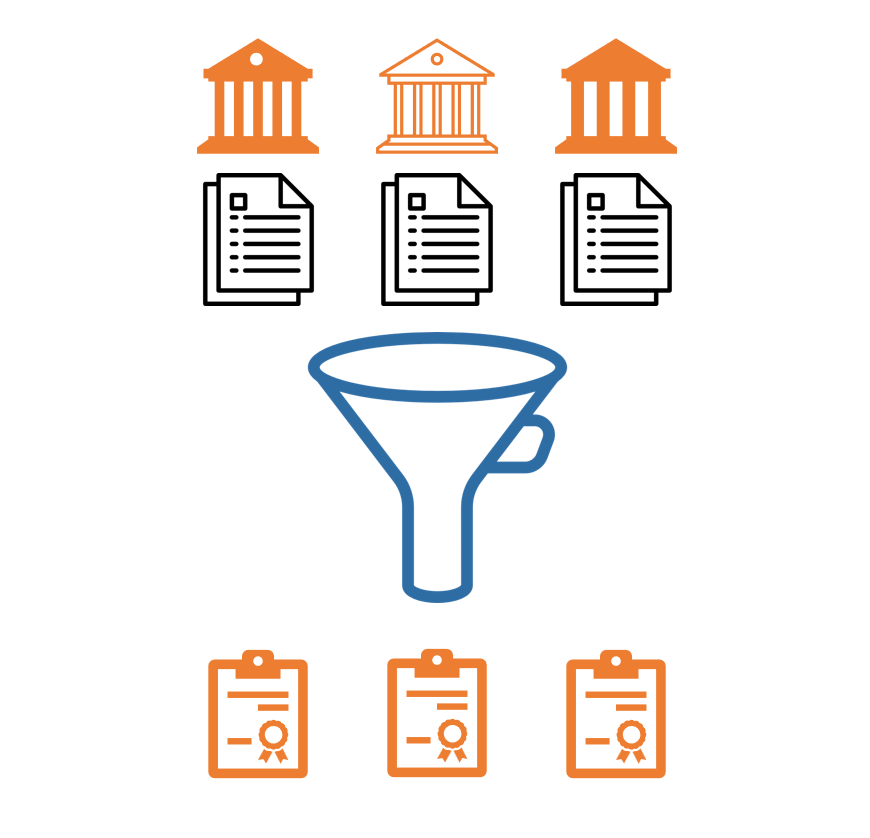
We have a Process Problem!
“We have too many process requirements and regulations, and they have been implemented inefficiently!”
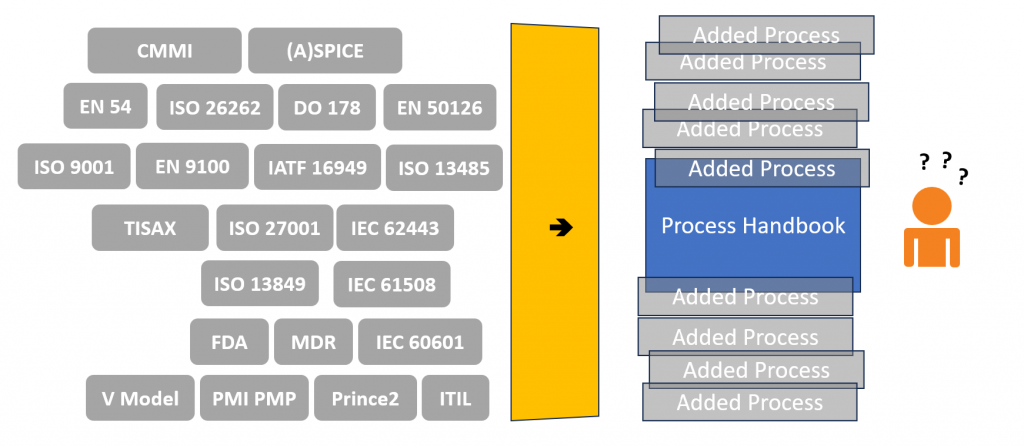
1. Many organizations are stifled by regulations and process requirements.
- Implemented separately, they become an overwhelming nightmare. Many process standards require similar roles and practices in principle. Duplicate responsibilities and duplication of work are inevitable.
- Process managers are already working at full capacity to ensure compliance with existing standards. There is no capacity available for the integration of modified and new standards.
- Some organizations separate the executed process from the documentation of the regulated process, which leads to late surprises, delays, and additional work.
2. Agile methods were understood to mean that processes are unimportant. This has often resulted in parallel structures.
- The parallel structures and breaks in the processes cause misunderstanding, duplication of work, additional costs, and frustration. This sometimes goes so far that organizations abandon the topic of lean and agility altogether.
3. Software development for web applications has been largely unregulated until now. This has often allowed for pure agility without processes. But that has changed! Requirements for IT security, data protection, and accessibility have increased significantly and are now regulated. Product liability for software, web pages and AI will com into effect in 2026.
How can the problem be solved?
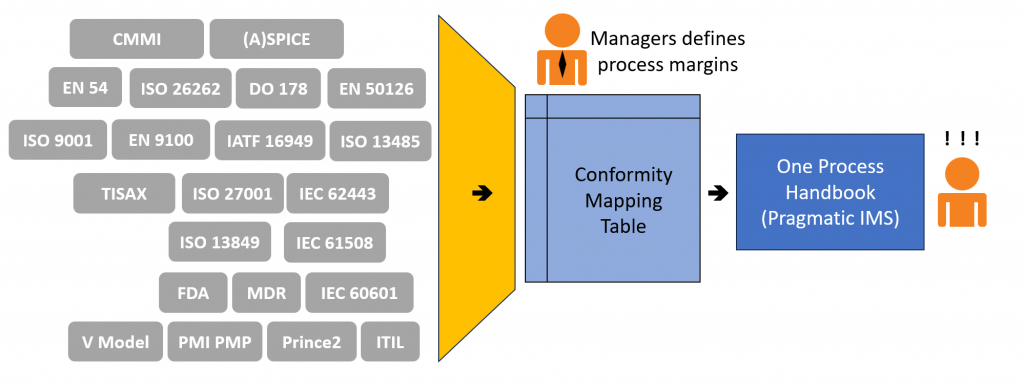
The solution is not to implement them additively or to fight them, but rather to …
- integrate them into a streamlined framework and establish Multiple Process Compliance (MPC) through Conformity Mapping.
- use a pre-audited process framework.
- automate tedious and error-prone tasks using AI.
- enable human tasks to be performed by the right people at the right time.
Our P4-DevOps forms this smartly linked framework.
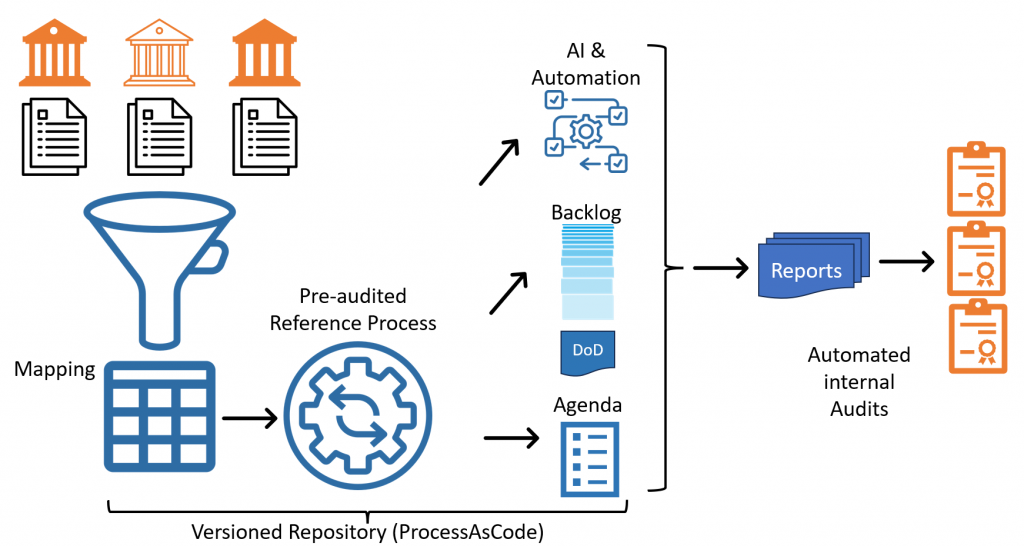
Our ProcessAsCode* approach allows the mapping and process description to be adapted, expanded, and maintained in a versioned manner. ProcessAsCode is similar to DocsAsCode (or Documentation-as-Code) an approach to creating technical documentation that uses the same tools, workflows, and principles as in software development.
How does that work in practice?
“Mapping, Automation & Integration into a modern and lean reference process”
What can we do for you?
1. Continuous monitoring of relevant process standards
2. Atomization of versioned process standards into objects
3. Linking process requirements to the reference process (pre-audited)
- Standardized roles and responsibilities, team templates
- Automated meeting agendas, tasks/backlog items, DoDs
4. Adaptation, derivation, or linking to your target process
5. Optional: Connection to planning tools (Jira, ADO, Odoo)
What do you have to do?
Use of templates to carry out the simplified process. That’s it.
- (Automatic) storage and linking of process documentation (evidence).
- Optional: Use of AI for automatic document generation.
Result: Automatic continuous internal audit reports and deviations.
Overview of the System
Advantages
- Effective and efficient: doing the right things right, but only once. Potential savings: 20–30%!
- Automation reduces human effort. (10–25%)
- The process is carried out by the right people at the right time. (~20%)
- Enables and maintains the flexibility of the teams carrying out the process, as the process requirements are minimal and leanly integrated. Result: More satisfied employees and teams.
- No more audit stress thanks to automatic continuous compliance checks. External audits become significantly simpler and easier to achieve.
- Much of the process work can be outsourced to P4-DevOps: Potential savings in monitoring, linking, and adaptation: 30-50%.
What does it take?
… and how can P4-DevOps support?
- The current situation: “Where are we now?” (Gap analysis by P4-DevOps)
- Which regulations and process standards are currently being met?
- Which processes have we defined for this purpose?
- Which work processes are actually being carried out?
- What potential savings exist?
- Do we already have an iteratve incremental product-oriented operating model? The closer the operating model is to the P4 reference process, the easier it will be to implement!
- A clear goal: “Where do we want or need to go?” (Vision together with P4-DevOps)
- Which regulations and process standards will be added and when?
- What steps do we want to take to move toward the goal?
- Which processes will be changed, which will remain, and which will be eliminated?
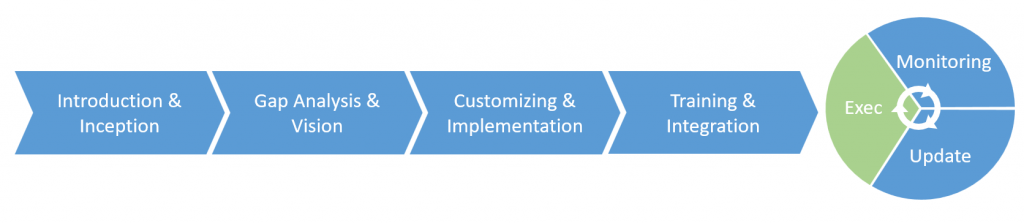
Implementation Phase Plan
Have we sparked your interest? Get in touch with us: info at p4-devops.com
Here we explain P4-DevOps with the navigation system metaphor.