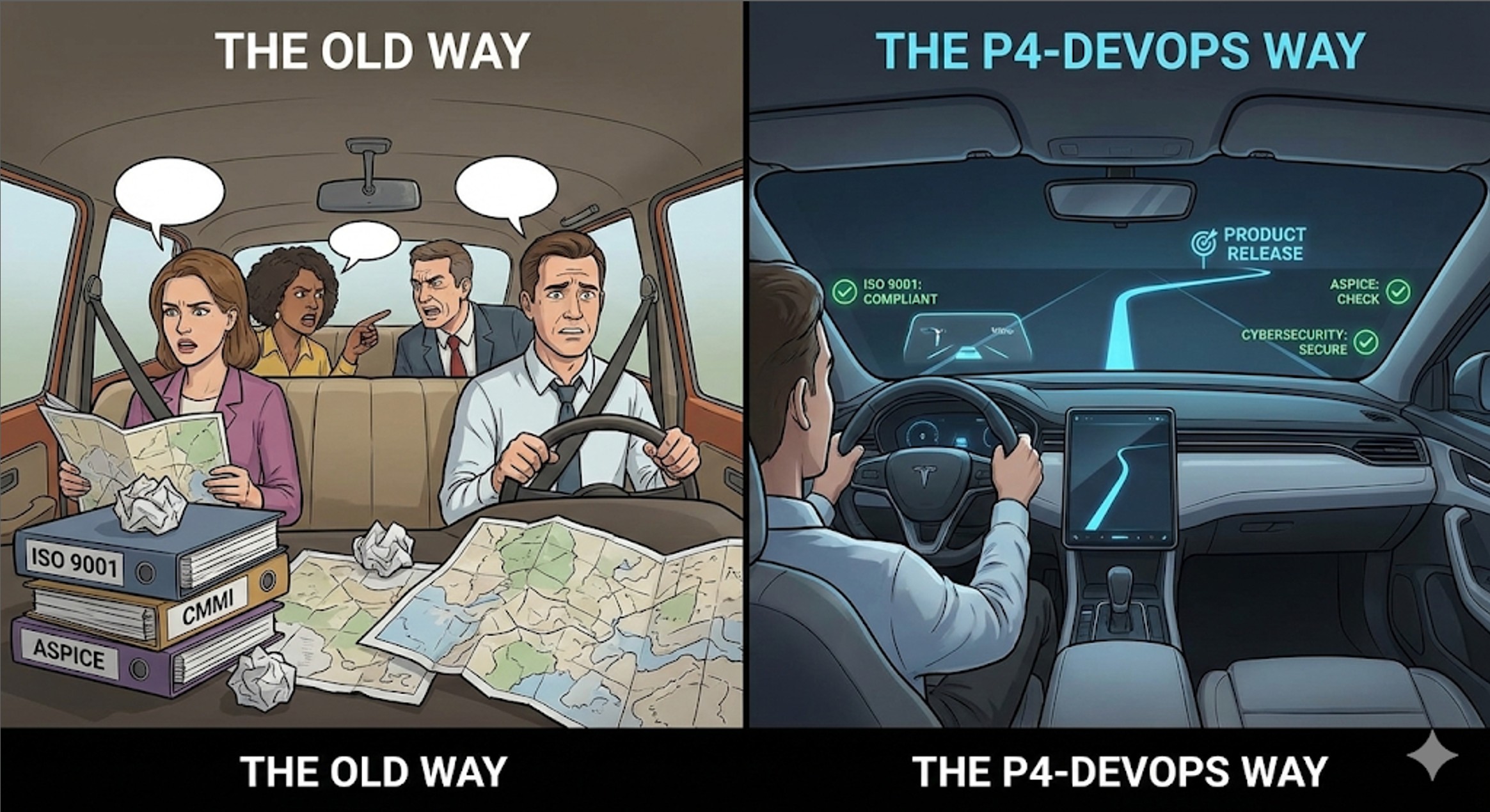
The comparison: In the past, you had to spend hours studying the paper map (the process manual) before setting off and hope you didn’t miss a turn. Today, you just get in the car and drive off. The navigation system knows the destination. If a road is closed (a standard changes), the navigation system is immediately updated by downloading the new map and calculates a new route.
The message for P4 DevOps users: The developer holds the steering wheel and concentrates on the road (product development). P4 DevOps runs as a navigation system in the background and ensures that the company complies with traffic regulations (compliance) without the driver having to remember the rules.
The environment is changing (New standard version = The new construction site)
The metaphor: Imagine that lawmakers change the traffic regulations. At an important intersection, “right before left” suddenly applies instead of a traffic light (e.g., an update from ISO 27001 to a new annual version).
The problem in the old world: Until now, you had printed paper maps (static PDF process manuals). When the road changes, you have to throw away the map, hire a cartographer (consultant), and have a new map drawn. Your drivers (developers) drive blindly or incorrectly for months.
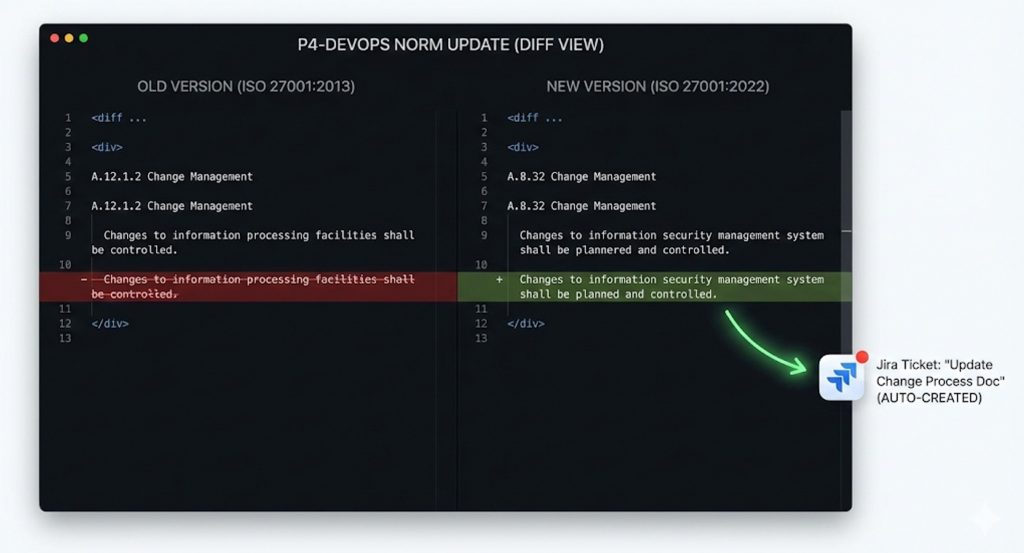
The P4 solution (“over-the-air update”): P4 DevOps acts as a cloud server for the navigation system. We constantly scan the “traffic rules” (standards). When ISO is updated, we import a map update into the P4 repository.
The impact on the driver (traceability & diffing)
If so, the navigation system will notify you the next time you start driving: “Attention, a rule has changed on your usual route. Please review this document at intersection X (activity: team review) and set the new documentation check mark.”
Versioning and traceability (the digital logbook)
The problem in the old world: No one knows anymore which Word document was valid on May 12.
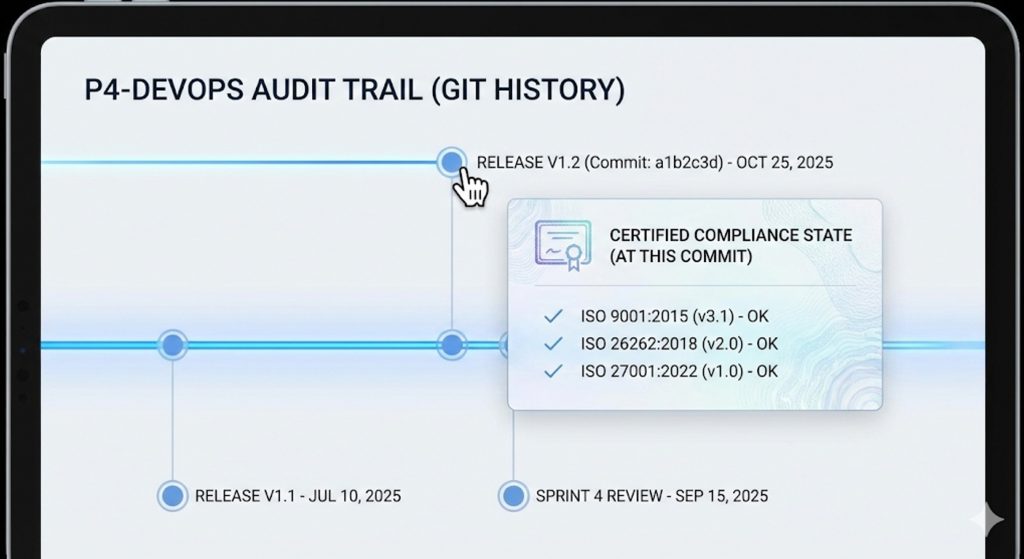
Result: At the touch of a button, you can prove to the auditor: “At the time of the commit, our route was 100% compliant with the road traffic regulations at that time.”
Life updates
With P4-DevOps, you’re not buying a static process manual; you’re subscribing to our ‘Live Traffic & Update’ package. When the CMMI consortium releases a new version, we do the work. We analyze the ‘construction site’, update the mapping in our central repository, and push the patch to your system. This keeps your audit trail (the logbook) intact, your history is securely versioned, and developers simply continue on their way – always on the legally compliant route.
Multiple Process Compliance
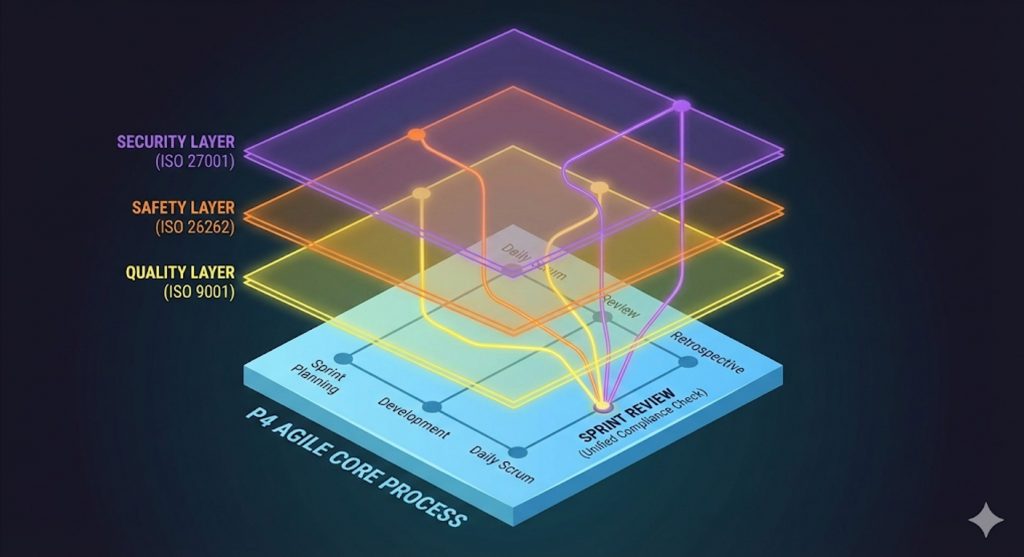
The problem in the old world: three arguing passengers. Imagine you are driving a hazardous goods transport through Europe. You have to observe the normal traffic rules (ISO 9001 / Quality), adhere to the extremely strict hazardous goods routes (ISO 26262 / Safety), and comply with customs and security protocols at the borders (ISO 27001 / Security) . Until now, this meant you had three passengers (quality manager, safety manager, security officer) with three different paper maps on their laps. They all shouted different instructions at you at the same time. The team was frustrated, and the transport barely made any progress.
ProcessAsCode
A PDF manual or Excel matrix is like a printed photo of a map. You can’t zoom in (it becomes pixelated), you can’t filter routes, and if you want to draw in a new road, you have to scribble on the paper with a marker. It’s dead material.
The P4-DevOps solution: Real vector data & coordinates (process-as-code)
P4-DevOps does not provide “images” of processes. Our navigation system is based on raw vector data and coordinates (code).
Every activity (e.g., sprint planning), every artifact, and every standard requirement is a single, smart data object (like a coordinate on the map).
The advantage: Because it is code, we can manipulate the map dynamically.
Example Tailoring: Don’t want to use a road (activity) in your project? Just click it away. The navigation system immediately recalculates whether you will still reach your destination (the audit).
Branching (customer variants): Process-as-code in a Git repository (our logbook) allows us to give the customer an exact copy of our world map (a branch). They can build new roads in their city, but still receive satellite updates (standard changes) from us for the highways.
Summary of the metaphor
The paper map: Old PDF manuals. Static, quickly outdated.
The arguing passengers: Multiple process requirements (quality, safety, security) that are not harmonized in the process.
The P4 navigation system: Our system. Real vector data (process-as-code) instead of images.
The optimized route: Multiple compliance requirements combined in a single workflow.
The construction site/satellite update: Standard updates are seamlessly integrated.
The digital logbook: Forgery-proof Git versioning for auditing.