In every product development, there are design decisions that make the whole concept fly or make it impossible. These naturally have the greatest (risk) impact and should therefore be made first.
The decision tree answers the question of the importance and influence of Knowledge Gaps, and thus the order of processing and solution in the direction of a design decision. To do this, it is necessary to identify leading, subsequent and trailing Knowledge Gaps and put them in a sequence of dependent decisions.
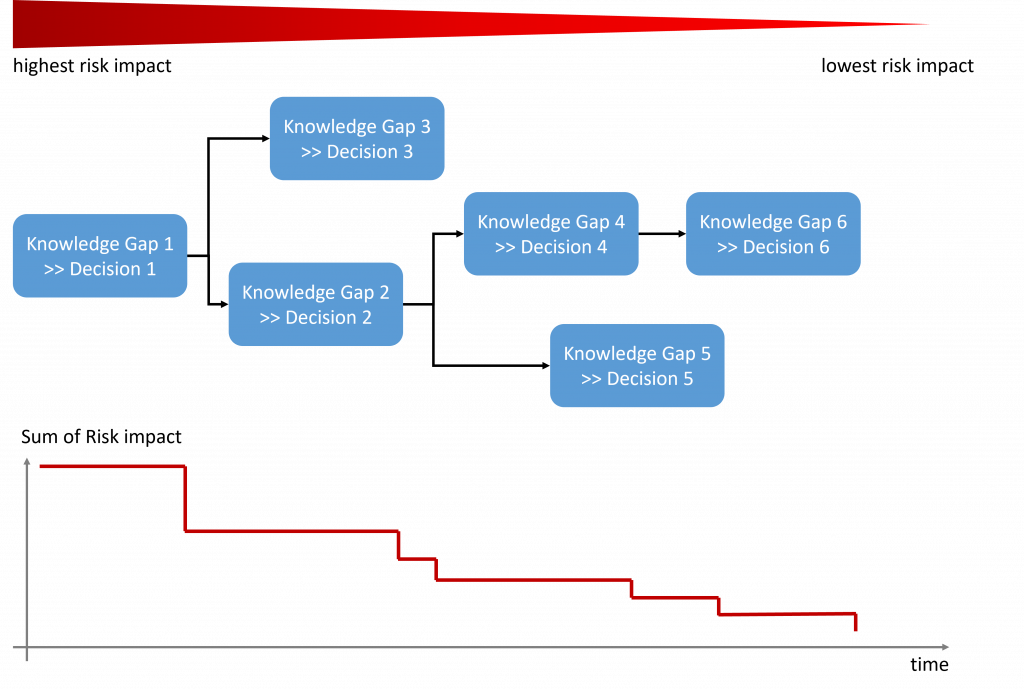
By prioritizing the processing of Knowledge Gaps according to their impact, the overall risk of a product development can be reduced as quickly as possible. This can increase the chances of success or the early cancellation of the product development to use the teams and resources working on more valuable endavors. Thus, using a Decision Tree is active risk management.